

The Console That Revived an Industry from Complete Collapse
I came to retro gaming without any childhood nostalgia. No rose-tinted memories of blowing into cartridges or begging my parents for a Nintendo. I’m a construction foreman who discovered this stuff at forty and immediately became obsessed. That means I judge the NES the way a genuinely curious adult would, not the way someone defending their childhood would. I’m here to tell you that the Nintendo Entertainment System is genuinely the most important console ever made. Not just commercially important. Structurally important. Philosophically important. The NES didn’t just save the video game industry. It invented the framework that the entire modern industry still operates within.

NES Technical Specifications and Sales Data
| Specification | Details |
|---|---|
| Release Date | July 15, 1983 (Japan), October 18, 1985 (North America) |
| CPU | Ricoh 2A03 (6502-based) at 1.79 MHz NTSC / 1.66 MHz PAL |
| RAM | 2 KB main RAM, 2 KB video RAM |
| Video Resolution | 256×240 pixels |
| Sprites | Up to 64 sprites (8×8 to 8×16 pixels) |
| Color Palette | 52 colors with 25 simultaneous on screen |
| Audio | 5-channel (2 square waves, triangle, noise, sample) |
| Lifetime Sales | 61.91 million units worldwide |
| Generation | 8-bit home console |
The Context: Why the Industry Was Actually Dying
In 1983, video games were basically dead in North America. I mean genuinely dead. The Atari 2600 had proven that home gaming was possible, but the market had absolutely collapsed. Publishers were dumping garbage games onto the market with no quality control whatsoever. The E.T. cartridge is the famous example, but it was way worse than just one bad game. There were hundreds of terrible games flooding the market. Retailers stopped buying video game inventory because they didn’t trust the product anymore. Parents stopped buying consoles because they’d been burned. The entire home video game market had basically evaporated by 1983.
The market needed to be rebuilt from scratch. Not just fixed. Rebuilt. And Nintendo understood something that nobody else got. They understood that you couldn’t just release a machine with games. You had to release a machine with standards. You had to prove to retailers and parents that this product was trustworthy. You had to make it clear that Nintendo was taking quality seriously. You had to do things differently than Atari had done them.
The Famicom: Japan Gets It First
The NES released in Japan on July 15, 1983 as the Famicom and in North America on October 18, 1985. It used a Ricoh 2A03 CPU (6502-based) running at 1.79 MHz NTSC / 1.66 MHz PAL. The hardware had 2 KB of main RAM and 2 KB of video RAM. The PPU supported 256×240 resolution with up to 64 sprites (8×8 to 8×16 pixels) and a 52-color palette with 25 colors simultaneous on screen. The audio system had five channels including two square wave generators, a triangle wave, noise, and a sample channel. Lifetime sales reached 61.91 million units worldwide. These specs sound pathetically weak by modern standards, but in 1983 they were sufficient. What mattered wasn’t the specs. What mattered was that Nintendo proved the concept worked.
What mattered wasn’t the specs. What mattered was that Nintendo proved the concept worked. The Famicom sold incredibly well in Japan. By the time Nintendo was ready to release it in North America, they had an absolutely stacked library of games that had already been proven to sell in Japan.
The NES Redesign: Nintendo Understood American Retail
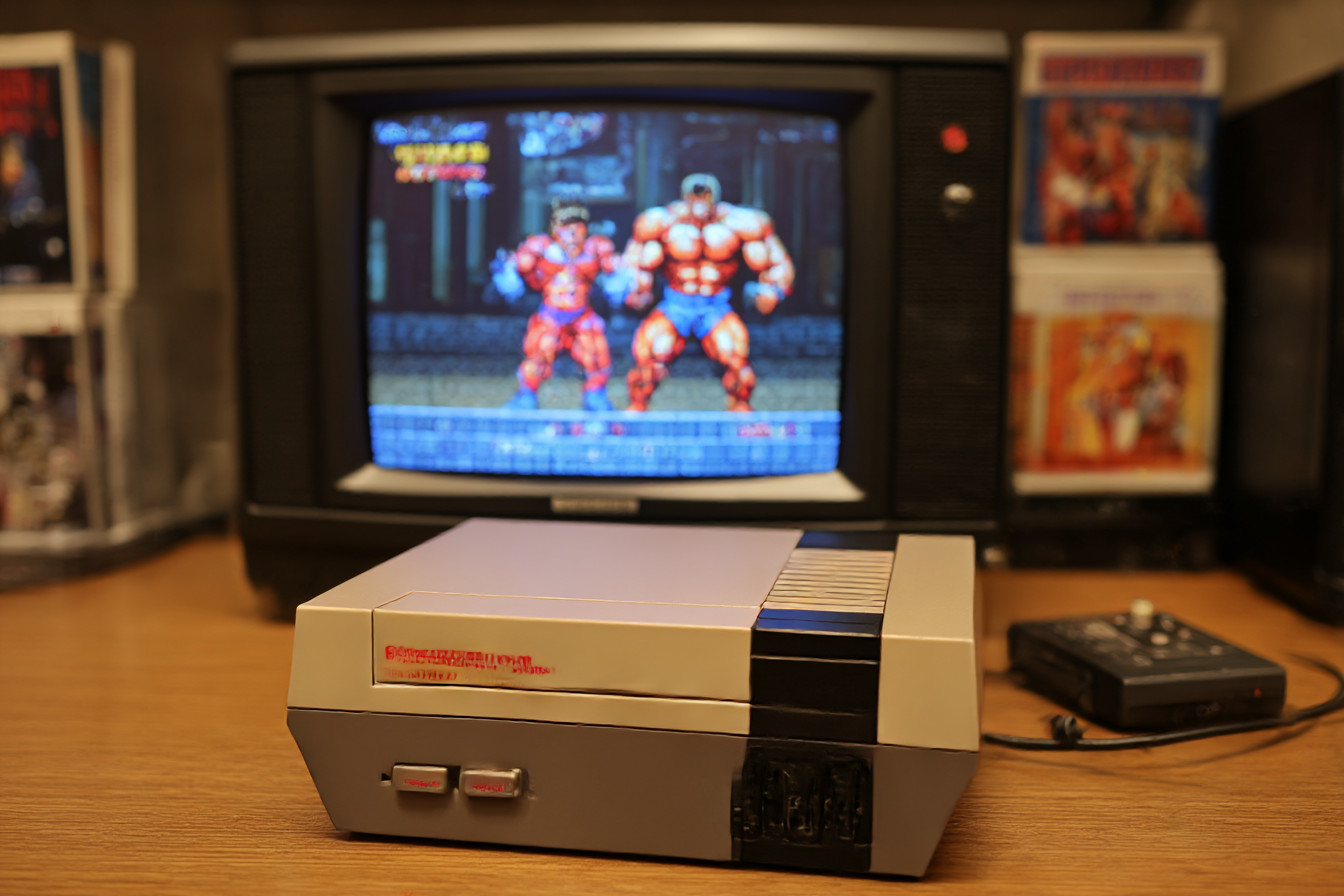
Nintendo didn’t just take the Famicom and rebrand it for North America. They redesigned it. The American NES looked completely different from the Famicom. It had a front-loading cartridge design instead of a top-loader. It looked like a VCR instead of a toy. This was intentional. Nintendo understood that American retailers had been burned. They wanted the NES to look like serious consumer electronics, not a toy. They wanted it to sit on your entertainment center next to your VCR and your television.
The NES launched in North America on October 18, 1985, two years after the Famicom hit Japan. Nintendo had spent that entire time making sure the library was ready. Super Mario Bros., The Legend of Zelda, Donkey Kong, Excitebike, 1942. These weren’t shovelware. These were games that had been specifically designed for the hardware. Games that showed what the NES could do. Games that people actually wanted to play.

The Cartridge Lockout Chip: Quality Control as Hardware
Here’s the thing that nobody else had done before. Nintendo put a lockout chip in the NES cartridge slot. Unlicensed games couldn’t play on the system. Only cartridges that Nintendo had approved could work. This sounds cynical. It sounds like Nintendo being proprietary and controlling. But it was actually brilliant. It meant that if a game had the Nintendo seal of approval, you could actually trust it. You could walk into a store, see that seal, and know that Nintendo had reviewed this game. Nintendo had tested it. Nintendo believed it met quality standards.
For retailers who had been completely burned by the Atari crash, this was everything. For parents who had been burned buying their kids bad games, this was security. For consumers, it meant that the NES library had standards that didn’t exist anywhere else. The lockout chip wasn’t anti-consumer. It was pro-consumer. It was Nintendo saying “we’re willing to stake our reputation on every game we approve.”
The Library: Games That Actually Mattered
The NES library became absolutely dominant. Super Mario Bros. alone sold over 40 million copies. The Legend of Zelda became a genuine phenomenon. Metroid created an entire genre. Castlevania IV showed what the NES could do with action platformers. Mega Man II, Mega Man III, Mega Man IV, Mega Man V. The Mega Man series alone was incredible. Final Fantasy, Dragon Quest, Kirby’s Dream Land, Donkey Kong Country, Double Dragon. The library depth was absolutely staggering.
What made these games special wasn’t just that they were good. It was that they were specifically designed for the NES hardware. Developers understood the 6502-based CPU and the PPU’s capabilities. They understood the 2 KB RAM limitation and worked within it. They understood the color palette constraints and used them creatively. Every game on the NES was basically built from the ground up for that specific hardware. There was no porting from arcade games that didn’t quite work. There was no “this was designed for more powerful hardware and we’ve watered it down.” There was just games that were designed specifically for what the NES could do.
Technical Achievement: Making 2 KB of RAM Feel Like Enough
The NES had 2 KB of main RAM. Two kilobytes. That’s 2,048 bytes. To put that in perspective, a single image file today is thousands of times larger. A single email is bigger than the entire NES RAM. How did games like Super Mario Bros. work with 2 KB of memory? The answer is brilliant engineering and game design that understood the constraints.
The NES CPU had a clock speed of 1.79 MHz NTSC or 1.66 MHz PAL. That sounds impossibly slow. Modern processors run at gigahertz speeds. But the NES software was written in assembly language. The developers understood every cycle. They understood exactly how many clock cycles each operation took. They optimized ruthlessly. Games didn’t have physics engines. They had hardcoded behaviors that made sprites move the way they should. The PPU handled the graphics rendering, freeing up the CPU to focus on game logic.
The 256×240 resolution seems primitive until you realize that it was perfectly adequate for the kinds of games being made. The 52-color palette with 25 simultaneous on-screen colors meant that developers had to be creative with color usage. You couldn’t just make everything colorful. You had to make choices about which colors mattered. Which colors conveyed information. Which colors made the game readable and playable.
The five-channel audio system with two square wave generators, a triangle wave, noise, and a sample channel meant that composers created actual music on hardware that had serious constraints. The soundtrack to Super Mario Bros. is iconic because it’s good music composed within very specific technical limitations. That’s not a drawback. That’s why the soundtrack is memorable. Composers had to be creative. They had to make every note count.
The Controller: Two Buttons and a Directional Pad
The NES controller is genuinely one of the greatest pieces of hardware design ever made. Two buttons. A directional pad. That’s it. No analog stick, no motion controls, no back paddles, no triggers. Just the D-pad and two buttons. But the ergonomics, the responsiveness, the way it felt in your hands, it was perfect.
Games were designed around that controller. Developers knew exactly what the player could and couldn’t do with the input. There was no guessing about complex control schemes. The directional pad moved your character in four directions. Button A did one thing. Button B did another thing. Games communicated that clearly. Players understood immediately how to play. The learning curve was minimal. You picked up the controller and you understood what it did.
The D-pad became the standard for console gaming for the next thirty years. Every console controller that came after the NES basically had a directional pad because it worked so well. The NES proved that you didn’t need complex controls to make engaging games. You just needed controls that felt right and games that made sense with those controls.
Sales and Market Dominance
The NES sold 61.91 million units worldwide over its lifetime. That’s an absurdly high number when you realize that the global video game market barely existed in 1983. That’s not just a commercially successful console. That’s a market-defining phenomenon. The NES didn’t capture the market. The NES created the market. It proved to retailers, parents, and consumers that home video games were a legitimate product worth buying.
By the time the NES was done, it had basically defined what a home console should be. It had proven that cartridge-based gaming could work. It had shown that quality control mattered. It had demonstrated that first-party software could drive hardware sales. It had established that controller design was crucial. Every console that came after learned from the NES. Some did things differently. Some did things better. But all of them were operating within a framework that Nintendo had established with the NES.
Does the NES Still Hold Up?
I played the NES for the first time without any nostalgia clouding my judgment. I was a forty-year-old who’d never blown into a cartridge before. Here’s what I found. The games are still genuinely good. Super Mario Bros. is still fun to play. The level design is still clever. The difficulty curve is still well-balanced. The Legend of Zelda still feels like an adventure. Metroid still feels like exploration. Castlevania IV still feels challenging and fair.
The controller still feels great. The responsiveness is still there. There’s no input lag. When you press a button, the character reacts immediately. The D-pad still feels accurate. It’s still the best way to play 2D games. There’s no jank. No weird unresponsiveness. Just precision controls that work.
The graphics still look clean and readable. The sprite work is expressive. Mario’s animations tell you what he’s doing. The enemies are clearly defined. The platforms are clearly visible. The art direction is still strong. The games don’t feel dated. They feel timeless in a way that a lot of 3D games from the same era don’t.
The audio still sounds good. The soundtrack to Super Mario Bros. is still catchy. The sound effects still convey information. The beeps and boops still feel like intentional composition rather than just noise. The 5-channel audio system produced music that was remarkably sophisticated for the hardware.

Why the NES Mattered Historically
The NES saved the video game industry. That’s not hyperbole. If the NES had failed, if Nintendo hadn’t understood how to rebuild trust with retailers and consumers, the home video game market might have stayed dead for years. The arcade industry might have continued to dominate. Home computers like the Commodore 64 might have become the primary gaming platform. The industry could have developed completely differently.
But the NES succeeded. It proved that home gaming was viable. It proved that quality control mattered. It proved that first-party software could drive hardware success. It proved that controller design was crucial. It established standards for how a home console should work. Every console that came after, from the SNES to the PlayStation to the Xbox to the Switch, is operating within a framework that Nintendo established with the NES.
The NES didn’t just save an industry. It created an entire framework for how the gaming industry would develop for the next forty years. That’s not just important. That’s historically monumental.
Conclusion
The Nintendo Entertainment System is the most important console ever made. Not because it had the best hardware. Not because it had cutting-edge graphics or processing power. It was important because it understood what the market needed. It understood that trust mattered. It understood that quality standards mattered. It understood that games designed specifically for the hardware mattered. It understood that controller design mattered. It understood that first-party software could define a platform.
I came to the NES without nostalgia and I found a genuinely great console. The games still work. The controller still feels right. The library is still incredible. The design philosophy is still sound. Forty years later, the NES is still a joy to play.
That’s not nostalgia talking. That’s just the truth about what Nintendo built.
Rating: 10/10 — The console that saved gaming and created the framework for everything that followed

Timothy discovered retro gaming at forty and immediately became obsessed, never looking back. By day he’s a construction foreman building modern homes; by night he’s a dedicated collector acquiring machines and cartridges with methodical focus. His unique angle comes from approaching classic games without childhood nostalgia clouding his judgment—he explores them with adult curiosity, offers brutally honest takes on their actual quality, and refuses to forgive games simply because they’re old. This fresh perspective has made him invaluable for readers tired of purely sentimental gaming writing.