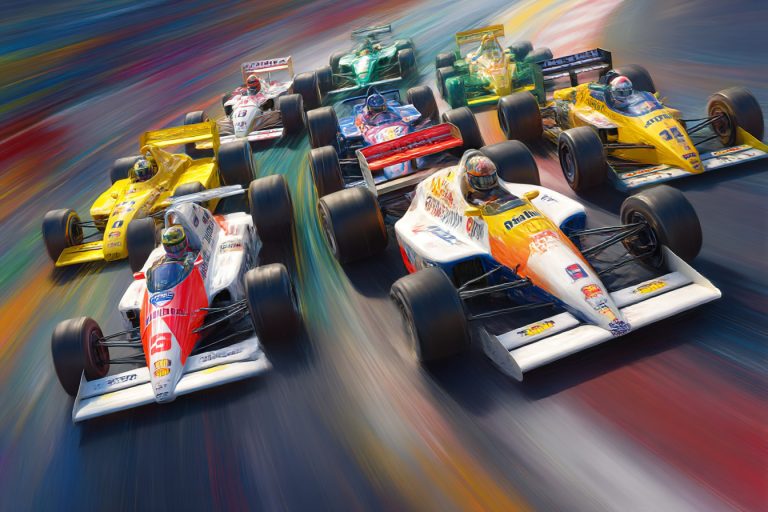

The Technical Evolution of Racing Games: From Vector Graphics to Polygons
I spent my career as a software engineer debugging games before the industry transformed beyond recognition. I understand what it takes to ship code on limited hardware. I understand the impossible optimizations required to make a game feel responsive when you’re working with kilobytes of memory and a CPU running at single-digit megahertz. Racing games are the perfect lens through which to examine the technical evolution of the 80s and 90s because each generation had to solve the same fundamental problem: how do you make speed feel real on hardware that’s fundamentally limited?
The 80s and 90s saw racing games evolve from simple arcade vector graphics to full 3D polygon rendering. Each innovation wasn’t incremental. Each was a fundamental rethinking of how to deliver the sensation of speed within the constraints of available hardware. This ranking acknowledges both commercial success and technical achievement, recognizing that the best racing games were those that understood their hardware deeply and pushed it further than anyone thought possible.
1. Super Mario Kart (SNES, 1992) – The Genre Originator With Four-Player Split-Screen
Super Mario Kart released in Japan on August 27, 1992, in North America on September 1, 1992, and in Europe on January 21, 1993. This is the game that originated an entire genre. Before Super Mario Kart, kart racing didn’t exist as a category. There were racing games. There were Mario games. Combining them with four-player split-screen multiplayer was the innovation that changed everything.
The technical achievement here is often overlooked. The SNES had a Ricoh 5A22 CPU running at 3.58 MHz with 128 KB of main RAM and 64 KB of video RAM. Making four-player split-screen racing work on that hardware was a remarkable engineering feat. Each player got a quarter of the screen. The tracks had to be designed so that four simultaneous viewpoints made sense. The collision detection had to account for four racers moving at different speeds. The power-up system had to be fair across all four players.
Super Mario Kart sold 8.76 million units worldwide, making it the 4th best-selling SNES game. The game was the #1 seller in Europe in Q1 1993 and reached over 250,000 units in the UK alone. This wasn’t just a successful game. This was a phenomenon that proved multiplayer racing had massive commercial appeal.
The game featured 20 tracks across 4 cups, 8 racers, and pseudo-3D Mode 7 graphics. The Mode 7 effect made flat 2D sprites appear to rotate and scale, creating the illusion of 3D without actual polygon rendering. The power-up system was balanced so that losing players could catch up through luck while skilled players could still win through technique. The game understood that multiplayer fun required accessibility alongside skill expression.
Critical reception was unanimous acclaim, with Nintendo Life giving it 10/10 and IGN awarding 9.0/10 for the four-player split-screen innovation. The series would eventually sell over 166 million copies across all games, but it all started here with a technical achievement that proved split-screen racing was possible on 16-bit hardware.
2. Mario Kart 64 (N64, 1996) – The Technical Evolution That Went Fully 3D
We’re acknowledging that Mario Kart appears twice on this list because the franchise is that important. Mario Kart 64 released in Japan on December 14, 1996, in North America on February 10, 1997, and in Europe in June 1997. The N64 version wasn’t an incremental update. It was a fundamental rethinking of what kart racing could be in full 3D.
The technical challenge was significant. The N64 had a Hitachi/NEC VR4300 CPU at 93.75 MHz with a Reality Co-Processor for graphics handling approximately 100,000 polygons per second. That’s dramatically more powerful than the SNES, but it also meant the game had to be designed for 3D polygon rendering instead of 2D sprite scaling. The tracks had to be rebuilt in 3D. The physics had to account for a full 3D space instead of a flat track with visual depth tricks.
Mario Kart 64 sold 19.93 million units worldwide, making it the 2nd best-selling N64 game after Super Mario 64 itself. The game maintained four-player multiplayer while jumping to genuine 3D, which was no small feat. The fact that the game could render four simultaneous 3D viewpoints at reasonable framerate was genuinely impressive hardware optimization.
The game featured 16 tracks plus battle arenas, 8 karts, and ran at 25 FPS with time trials and ghost data. The introduction of battle mode as a core feature (not just in later Mario Kart games, but pioneered here) created an entirely different way to play kart racing. Time trials with ghost data let you race against your own previous times. The game understood that multiplayer racing needed variety beyond just racing each other.
Metacritic rated the game 87/100, with EGM giving 9.25/10 and praising the four-player 3D racing and battle mode innovations. Some criticism about dated controls was fair, but the game’s technical achievement and commercial success proved that 3D kart racing on console hardware was viable.
Read why Joe thinks Mario Kart 64 is the bets racing game of all time
3. Gran Turismo (PS1, 1997) – The Sim Racer That Legitimized Console Racing
Gran Turismo released in Japan on December 23, 1997, in North America on April 30, 1998, and in Europe on May 8, 1998. This is the game that proved console racing could be serious. Before Gran Turismo, sim racing was the domain of PC enthusiasts with expensive steering wheel setups. Gran Turismo brought realistic racing physics to a standard console controller and proved that console players wanted authenticity alongside arcade fun.
The scope of Gran Turismo was staggering. The game featured 140 cars, 11 tracks with 36 variations, 5 camera views, and approximately 50 hours to achieve 100% completion. This wasn’t just a racing game. This was a racing simulator with the depth of a full career mode. You didn’t just race. You progressed through difficulty levels, purchased and tuned cars, and unlocked new content over dozens of hours.
Gran Turismo sold 10.85 million units worldwide, making it the 2nd best-selling PS1 game, with 2.45 million in Japan and 6.14 million in North America. The game’s commercial success proved that console players wanted depth and authenticity. The racing sim audience wasn’t limited to PC hobbyists. Console players would embrace realistic physics and lengthy career modes if given the chance.
Metacritic rated Gran Turismo 96/100, making it the highest-rated PS1 racer with IGN awarding a perfect 10/10. The critical reception acknowledged that this game wasn’t just technically accomplished. It was a complete rethinking of what console racing could be. The realistic physics model, the massive car roster, the track variety, and the career progression all contributed to a game that felt like a complete racing experience.

4. F-Zero (SNES, 1990) – The Futuristic Speed Experience
F-Zero released in Japan on November 21, 1990, in North America in November 1990, and in Europe in September 1991. This is the game that proved Mode 7 scaling wasn’t just a technical gimmick. It was a legitimate way to create the sensation of speed on 16-bit hardware.
F-Zero used the same Mode 7 effect as Super Mario Kart, but applied it to a completely different genre. Instead of casual kart racing, F-Zero was about high-speed futuristic racing where tracks twisted and spiraled in ways that would be geometrically impossible on a flat surface. The pseudo-3D effect made you feel like you were flying through space at impossible speeds.
F-Zero sold approximately 2.9 million units, boosted to 4.9 million estimated with bundle variants. The game was bundled with many SNES purchases in North America, which inflated the numbers, but the raw game sales were still impressive. The game launched the SNES in North America and proved that the console could deliver arcade-quality experiences.
The game featured 5 teams, 3 difficulty modes, a 50-track GP mode, and achieved speeds over 200 mph on screen. The sense of speed in F-Zero was revolutionary. Earlier racing games felt like cars moving across a flat plane. F-Zero felt like you were piloting a spacecraft at terminal velocity. The Mode 7 scaling made the track appear to approach and recede at incredible speeds.
5. Road Rash (Genesis, 1991) – The Traffic Racer With Attitude
Road Rash released in North America in September 1991 and across multiple platforms including Genesis, PC, Master System, Game Gear, 3DO, Saturn, and PS1. This is the game that proved racing games didn’t have to be about circuits. They could be about illegal street racing through traffic with motorcycles and chain-whip combat.
Road Rash was fundamentally different from every other game on this list. Instead of closed tracks, you raced through traffic on open roads. Instead of power-ups, you had weapons: chain whips, kicks, and punch combos you could use against other racers. The game was chaotic in ways that structured racing games weren’t.
The Genesis version sold approximately 1.5 million units, with the series total reaching 5+ million across all platforms. The commercial success proved that players wanted variety in racing game experiences. Road Rash proved that racing games could be about more than pure racing mechanics.
The game featured 3 bikes, 5 tracks across the US West Coast, and first/second/third-person views. The variety of perspectives let players choose how they wanted to experience the racing. The motorcycle handling was distinct from car racing. The combat system was novel and actually impacted race outcomes. You could win through pure speed or through aggressive combat tactics.
6. Pole Position (Arcade/NES, 1982/1983) – The Arcade Legend That Started It All
Pole Position released in arcades in June 1982 in Japan and the US, with NES ports arriving in 1983 and Europe in 1984. This is the game that established the template for racing games. Before Pole Position, there was no racing game template. Pole Position created it.
The arcade version was revolutionary. It featured a steering wheel controller, analog throttle and brake pedals, and a 3D first-person perspective. Players sat in an arcade cabinet that felt like driving a real race car. The experience was immersive in ways that were unprecedented.
The arcade version sold approximately 30,000 cabinets, making it one of the highest-grossing arcade games of the early 1980s. The NES port sold approximately 500,000 units, though it suffered from slowdown that the arcade version didn’t have. The commercial success of the arcade version proved that players wanted racing experiences and would pay for them.
Pole Position featured 4 tracks, a qualifying lap system, 8 cars, and ran on a Namco arcade board. The qualifying lap system was innovative because it meant you had to learn the track before racing against opponents. The game wasn’t about immediate gratification. It was about mastering a course and then competing.
7. OutRun (Arcade/Genesis, 1986/1989) – The Convertible Dream That Defined Arcade Racing Style
OutRun released in arcades in September 1986 in Japan and September 1987 in North America and Europe, with Genesis ports arriving in 1991. This is the game that proved racing games could be about more than speed and competition. OutRun was about the fantasy of driving a Ferrari Testarossa convertible down coastal roads with a beautiful passenger beside you.
The arcade cabinet was experience design. It featured a steering wheel, hydraulic motion, and speakers that blasted a synthesizer soundtrack. You sat in a cockpit designed to look like the interior of a sports car. The fantasy was complete and immersive.
The arcade version sold over 20,000 cabinets, with the Genesis version reaching approximately 1 million units and the series total exceeding 15 million. OutRun proved that arcade racing could transcend competition and become about lifestyle and fantasy. Players wanted to experience the dream of sports car ownership and freedom.
OutRun featured 15 tracks with 5 main route forks, pseudo-3D scaling, and 4 possible endings based on your decisions during the race. The branching paths meant that OutRun was about exploration as much as racing. The 4 different endings meant you had reasons to replay the game multiple times to experience different routes.
8. Wipeout (PS1, 1995) – The Anti-Gravity Racer That Proved Arcade Racing Belonged On Console
Wipeout released in Europe in September 1995, North America in November 1995, and Japan in 1996. This is the game that proved the PS1 could handle arcade racing with style. Wipeout was fast, sleek, and deliberately designed to showcase what the PlayStation’s polygon rendering could do.
The game’s aesthetic was integral to its success. The soundtrack featured rave and electronica artists including The Chemical Brothers and The Prodigy. The visual design was clean and futuristic. The game wasn’t trying to simulate reality. It was trying to create a stylized future racing experience.
Wipeout sold 1.5 million PS1 copies, with the series total exceeding 10 million across all platforms. The commercial success proved that console players wanted arcade-style racing with artistic vision. Wipeout proved that racing games didn’t have to chase realism to be successful.
The game featured 4 ships, 8 tracks, 3 weapons systems, ran at 50+ FPS, and included a techno soundtrack that was integral to the experience. The weapon system meant Wipeout was about more than pure racing. You had to manage shields, collect weapons, and engage in tactical combat while racing at high speed.
9. Daytona USA (Arcade/Genesis, 1993/1996) – The Stock Car Racer That Brought Arcade Authenticity Home
Daytona USA released in arcades in 1993 with Japan following in March 1994, and Genesis ports arriving in 1996. This is the game that proved arcade racing cabinets could be successfully ported to home hardware. Daytona USA was a phenomenon in arcades, and the Genesis version brought that arcade experience to living rooms.
The arcade version was technically impressive. It featured 60 FPS rendering with hydraulic motion, multiple players could link arcade cabinets for 8-player racing, and the experience was immersive and competitive.
The arcade version sold over 10,000 cabinets, the Genesis version reached approximately 500,000 units, and Saturn ports sold 1 million units. The commercial success across multiple platforms proved that Daytona USA had appeal beyond arcade enthusiasts. Home console players wanted authentic arcade racing experiences.
Daytona USA featured 3 tracks with 3 different views, stock cars, and achieved 60 FPS in the arcade version. The Genesis port was downgraded graphically compared to the arcade, but the core racing experience remained intact. The game understood that home ports of arcade games had to make compromises, but those compromises could still deliver fun.
10. Cruisin’ USA (Arcade/N64, 1994/1996) – The Arcade Road Trip That Brought Real-World Landmarks to Racing
Cruisin’ USA released in arcades in 1994 and N64 in North America in 1996 with Europe following in 1997. This is the game that proved racing games could be about exploration and sightseeing as much as pure competition. Cruisin’ USA took you on a road trip across America, racing through iconic landmarks and locations.
The arcade version featured hydraulic motion, steering wheel controls, and an immersive cabinet experience. The N64 port brought the essence of that arcade experience to home hardware.
The N64 version sold approximately 1.4 million units. The commercial success proved that console players wanted arcade racing games that were about more than circuit racing. Cruisin’ USA offered a unique experience that blended racing with tourism.
Cruisin’ USA featured 7 tracks representing real US roads, 4 cars, 2-player split-screen, and power-ups that affected gameplay. The real-world locations gave the game a sense of place that circuit racers lacked. You weren’t just racing. You were on a road trip across America.
The Evolution of Racing Games: What We Learned
These ten games represent the technical and commercial evolution of racing games across the 80s and 90s. We see the progression from arcade vector graphics to 2D sprite scaling to full 3D polygon rendering. We see the shift from pure racing simulation to arcade fantasy to lifestyle experiences.
What unites these games is that they all understood their hardware and pushed it further than anyone thought possible. They all found innovation beyond just “faster cars on faster hardware.” They all recognized that racing games could be about different things: competition, fantasy, style, exploration, or combat.
The 80s and 90s were the golden age of racing games because console hardware was advancing so rapidly that each new generation enabled fundamentally different game designs. A game that was technically impressive in 1990 looked primitive by 1995. A game that was commercially successful in 1992 had been superseded by something faster and more ambitious by 1997.
These ten games are the ones that transcended their era. They’re the ones that created templates other developers would follow. They’re the ones that proved racing games could be commercially successful across arcade, console, and home computer platforms. They’re the ones that made the 80s and 90s the golden age of racing.

Marcus is a retired software engineer from Seattle who spent his career debugging games before the industry transformed beyond recognition. He writes with technical precision about the engineering elegance behind classics, from Z80 assembly language to Mode 7 scaling tricks, treating code like archaeological artifacts worthy of study. His articles are deep dives into why certain games pushed their hardware to breaking points, paired with the dry humor of someone who’s actually shipped titles and understands the impossible constraints developers faced. For readers interested in the “how” behind their favorite games, Marcus is essential reading.